

News and Media

Ensuring the accuracy of satellite ocean colour products to build a long-term record of changes in phytoplankton in the global ocean

NCEO Scientists at Plymouth Marine Laboratory (PML) have conducted the largest ever global assessment of the accuracy of a wide range of satellite ocean colour products, which are developed by combining data from multiple satellites and used to examine the health and state of ocean ecosystems. The target accuracy of ocean colour Chlorophyll-a, a proxy for phytoplankton biomass, set by the Space Agencies is less than 35% error. The recently published paper, led by PML, showed that all of the satellite products assessed exhibited similar results and were within these limits with a mean error of 30%.
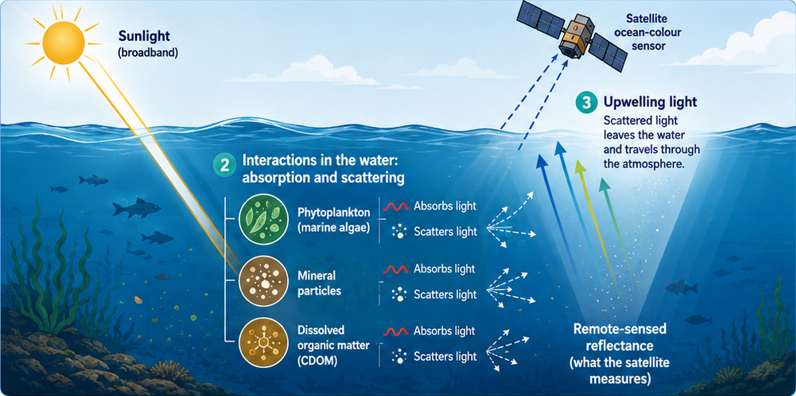
When sunlight enters the ocean, it interacts with substances in the sea, such as marine algae – the phytoplankton, mineral particles and dissolved organic matter, that absorb and scatter the light. A proportion of this scattered light is reflected back to the atmosphere and can be detected by satellite ocean colour sensors as the apparent hue or colour of the dominant particles or material. From this remotely-sensed reflectance, the quantity of the different materials suspended in seawater can be estimated. Microscopic marine algae – the phytoplankton are seen in the reflectance data as green, red-brown or chalky white, depending on the species. The green colour arises from the fact that blue and red light is absorbed by the principal active pigment, Chlorophyll-a, commonly the dominant pigment in phytoplankton.
The Global Importance of Phytoplankton
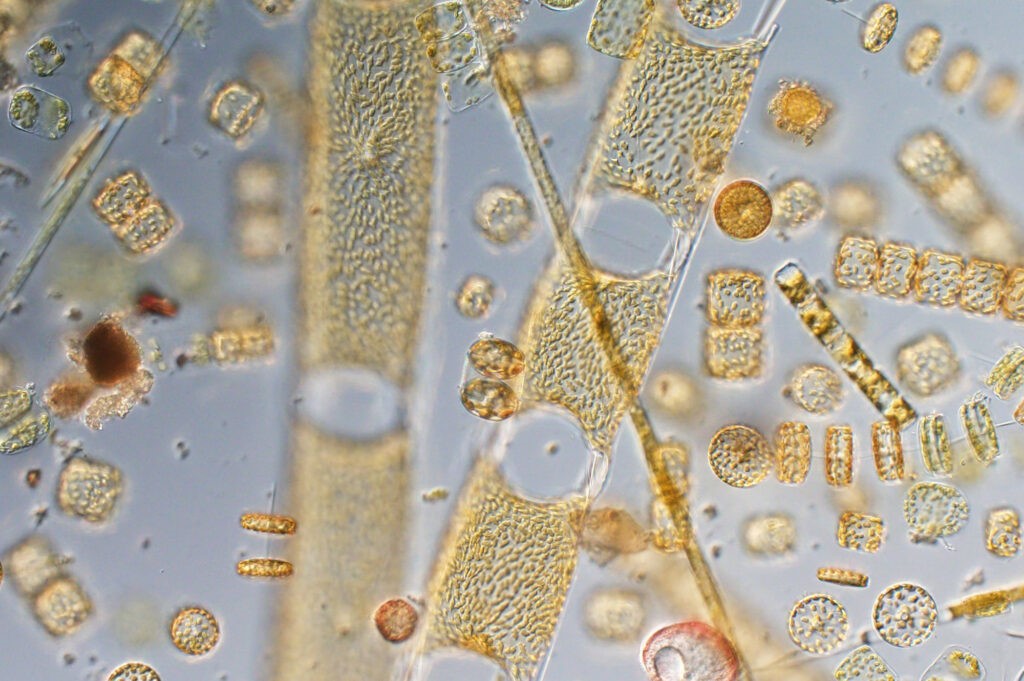
Phytoplankton form the base of the marine food web by converting sunlight, carbon dioxide, and nutrients into organic matter through photosynthesis. This energy supports zooplankton, krill, small fish, and larger predators such as whales, seabirds, and ultimately humans. Phytoplankton underpin fisheries, aquaculture, and marine livelihoods. Declines in their populations can directly affect food security and economies. Without them, marine biodiversity would collapse. Phytoplankton absorb CO₂ during photosynthesis, which regulates climate change. When they sink, fixed CO₂ is transported to the deep ocean, potentially locking it up for centuries. They also produce 50% of the Earth’s oxygen, which sustains life both in the ocean and on land.
Phytoplankton are critically important for life in the sea and on land. Human pressures on the oceans from climate change and pollution are impacting phytoplankton globally. Quality asssured satellite ocean colour data provides a means assessing the state and health of phytoplankton in the surface ocean around the globe”
Dr Gavin Tilstone
Joint lead author of the study
As the ocean warms, we need to observe and understand what is driving long-term changes in phytoplankton and the feedback that these changes can have on marine ecosystems and biogeochemical cycles. Satellite ocean colour has provided unprecedented observations of changes in surface phytoplankton biomass in space and time, and Chlorophyll-a is therefore classified as an Essential Climate Variable (ECV). There has been a concerted effort, through funding from the European Space Agency (ESA) and EU Copernicus Services, to produce long time-series of this ECV, to study global trends in phytoplankton Chlorophyll-a. To facilitate this, a range of multi-mission (NASA + ESA) satellite ocean colour products have been developed, that span almost 30 yrs (including Copernicus Marine Environment Monitoring Service – CMEMS, Global Ocean Colour for Carbon Cycle Research record – GlobColour and Ocean Colour – Climate Change Initiative -OC-CCI). The increasing duration of these products enables us to better assess the effects of climate change on phytoplankton biomass over the global ocean. Up to now, however, some of these products exhibit subtle differences in the trends in phytoplankton biomass that have been detected. For example, 23 years of OC-CCI and GlobColour data have shown a global decrease in Ocean Colour Chlorophyll-a from 1997 to 2018, though the trend in the GlobColour data was more pronounced than the OC-CCI data.
High quality in situ measurements of Chlorophyll-a collected over the lifetime of satellite sensors are fundamental to ensure the accuracy ocean colour data to build a robust time series to study what is happening to phytoplankton in our dynamically changing oceans”.
Dr Gavin Tilstone
Joint lead author of the study
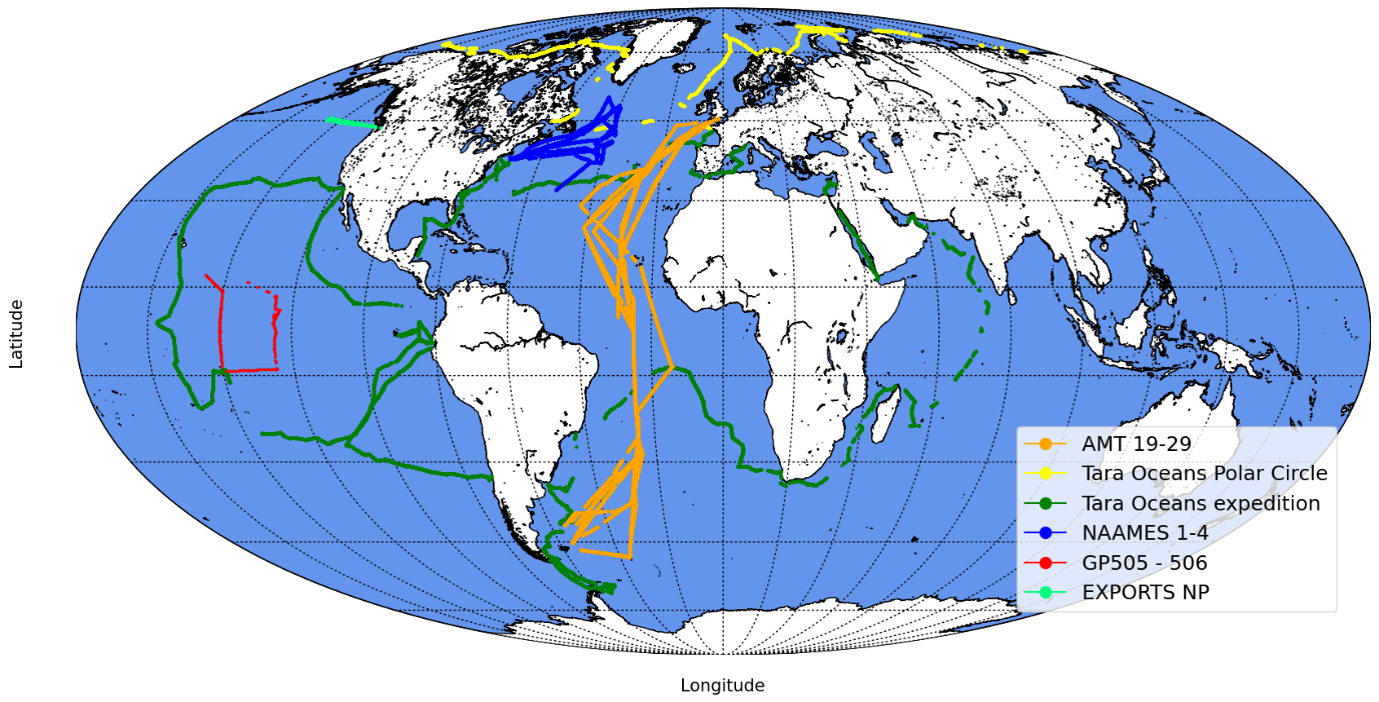
There has been a concerted push by the Space Agencies (especially ESA and NASA) for research institutes to collect very high quality in situ measurements of Chlorophyll-a, following accepted protocols and with error estimates, to `sea truth’ these satellite products. Plymouth Marine Laboratory (PML) have a long history of providing these measurements from the Atlantic Meridional Transect (AMT) research program, which is conducted almost every year from the UK to the South Atlantic to assess the health and state of the Atlantic Ocean. Through AMT, PML were awarded funding from ESA (through AMT4CO2Flux, AMT4OceanSatFlux, AMT4SentinelFRM contracts), which enabled them to develop protocols for these autonomous systems that produce very high-quality measurements for validating satellite ocean colour data. This means that whilst the ship is traversing through the ocean, theses high quality in situ measurements of remote sensing reflectance and Chlorophyll-a are being taken every minute. Through these contracts and additional funding from the National Centre for Earth Observation (NCEO), PML compiled these data alongside the same data collected by colleagues in the US, to produce a global database of >13000 data points that matched the ship borne measurements with satellite over-passes, with which they assessed the accuracy of seven multi-mission ocean colour products. All of these products showed a similar accuracy, with OC-CCI v6 and CMEMS CCI having a marginally improved performance compared to the other products.
“Field campaigns such as the Atlantic Meridional Transect, which samples across multiple oceanographic regions with a wide range of environmental conditions, enables us to produce high-quality reference data that are fundamental to assessing the accuracy of a range of Ocean Colour satellite products”.
Dr Tom Jordan
Senior Researcher, Plymouth Marine Laboratory
The full paper is available here:
Frontiers | Global assessment of merged multi-sensor ocean-colour chlorophyll-a products
Share this article


Published by Fazila Patel
Digital Comms Officer
University of Leicester
Latest News and Events
