

News and Media
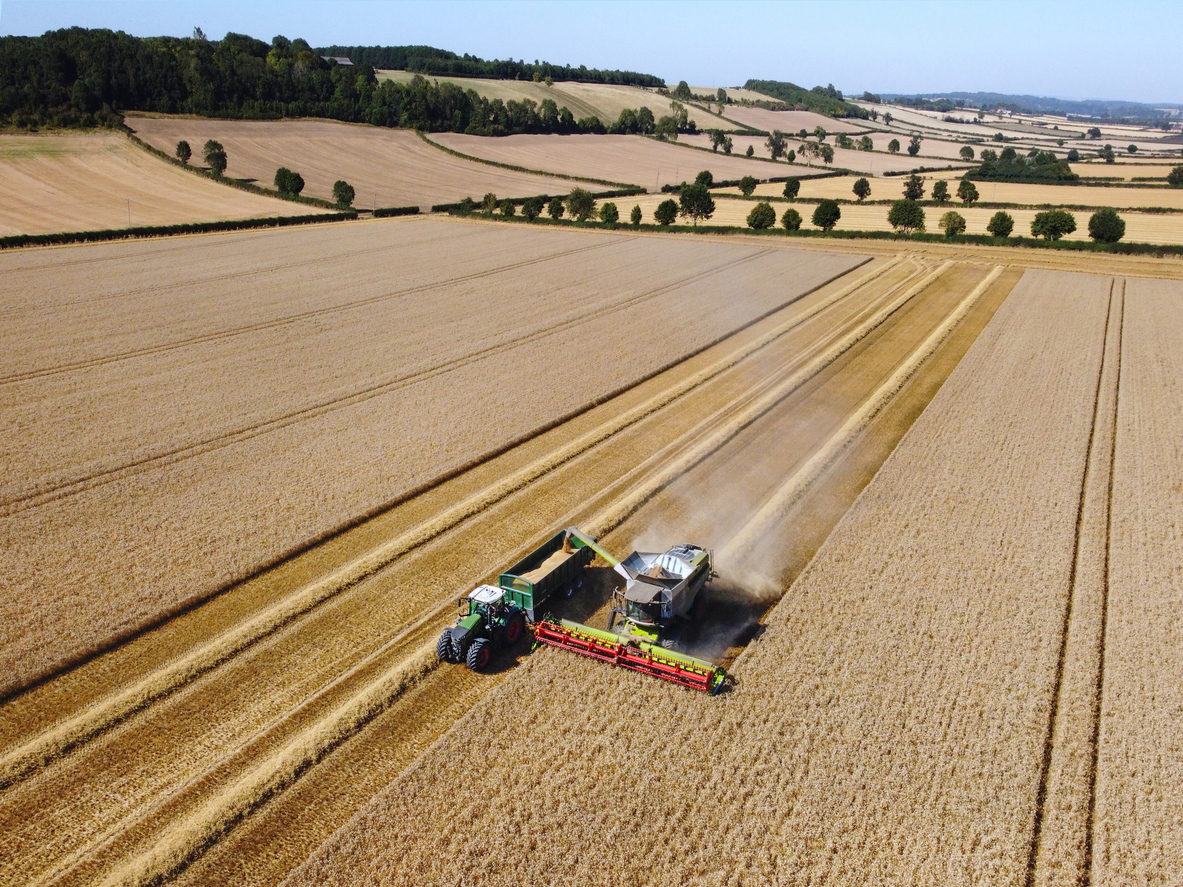
Satellite wheat forecasts offered an early counterpoint to harvest warnings

NCEO researchers at UCL are using satellite observations and crop modelling to provide earlier estimates of wheat yields, helping reduce uncertainty for farmers, agricultural markets and food-security planning.
Following an exceptionally dry summer and growing concerns about the UK harvest, NCEO researchers at UCL, working with the AgZero+ programme, produced a satellite-based outlook for wheat yields in Great Britain.
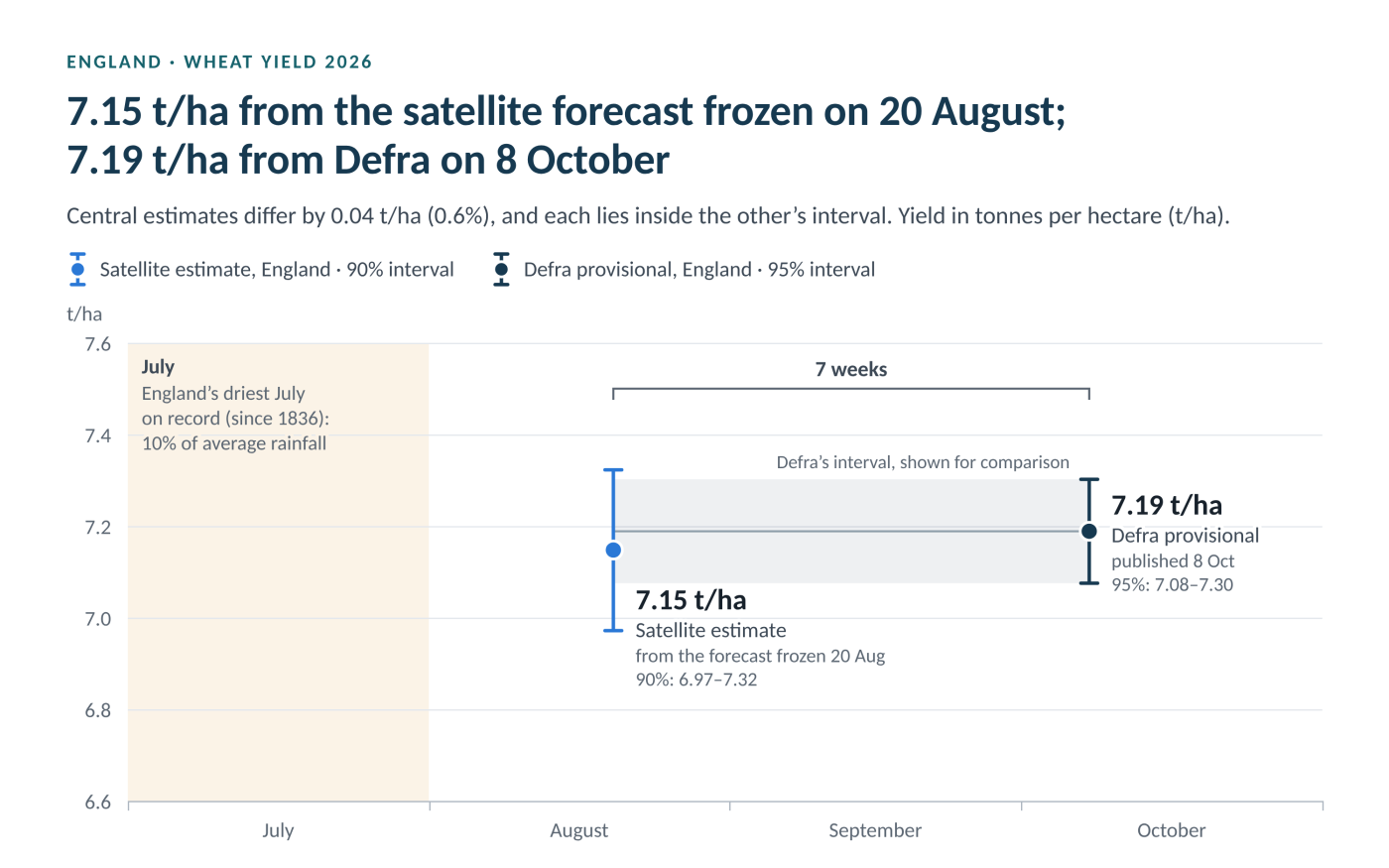
Their analysis indicated that wheat yields in England were likely to be below average, but that the reduction could be less severe than some estimates being reported at the time.
Importantly, the team’s forecast was produced in August, seven weeks before Defra published its official figures on 8 October. The subsequent official statistics provide an opportunity to compare the earlier satellite-based estimate with the final harvest data.
Providing evidence when uncertainty is high
England received just 10% of normal July rainfall, contributing to significant concern about the year’s cereal harvest. During August, a number of industry and media reports suggested wheat yields could be substantially below recent averages.
Against this backdrop, the research team issued its forecast on 17 August, with the results frozen on 20 August. Rather than replacing official statistics, the approach demonstrates how Earth observation could provide independent evidence earlier in the growing season, when farmers, businesses and policymakers are still making decisions.
From satellites to field-level insights
By combining repeated satellite observations with crop modelling, researchers can track crop productivity at field level throughout the growing season.
Separate validation carried out by the team has shown that estimates become increasingly accurate as the growing season progresses, with errors of around 1.5 tonnes per hectare by March and below one tonne per hectare by late May.
This could give farmers and the wider agricultural sector an earlier indication of how crops are developing before final harvest statistics become available.
Why earlier information matters
Weather extremes are creating increasing uncertainty for agriculture and food security.
Defra’s UK Food Security Report warns that more frequent and severe weather extremes will intensify yield variability and risks to global food prices and security. Market uncertainty has real consequences: UK Flour Millers reported a 17% rise in November feed-wheat futures between July and late September, amid domestic crop concerns and Black Sea disruption-not drought alone..[1][2]
More timely information about expected crop yields could therefore help:
- farmers plan inputs, expected volumes and cash flow;
- support buyers and agricultural businesses better plan procurement and manage risk;
- policymakers monitor emerging food-security pressures; and
- researchers and agronomists understand how crops respond to different weather conditions over time.
It is important that these estimates are seen as an additional source of evidence rather than a prediction of grain prices or a replacement for official statistics.
Beyond forecasting, these multi- year field records could also help farmers and researchers investigate persistent yield gaps, compare performance during dry and wet years, and assess how different agricultural practices contribute to more resilient farming.
Our aim is not to be more optimistic about a difficult harvest. It is to replace some of the uncertainty with independent evidence, so farmers, businesses and policymakers can act earlier and learn what makes farming more resilient.”
Dr Feng Yin
NCEO UCL
From research to practical use
The research brings together UCL, NCEO and AgZero+, the UKCEH-led programme funded by NERC and BBSRC. Opportunities to translate the research into practical applications are also being explored through RayX.
Sources
[1] Food security [2] Markets
Share this article


Published by Fazila Patel
Digital Comms Officer
University of Leicester
Latest News and Events
